

For families in Barkingside, a community pharmacy can be a useful first place to ask about everyday medicines, minor health concerns and which NHS route makes sense next. A pharmacist can advise on many common problems, but the right option depends on the person’s age, symptoms, medicines and medical history. This guide explains the family-focused role of a local pharmacy in Barkingside without turning that advice into a promise of treatment or a replacement for GP or urgent care.
If someone is very unwell, symptoms are rapidly worsening, or you are worried that the problem could be serious, ask for urgent medical advice rather than waiting for a routine pharmacy visit.
How a community pharmacy can support families
Family health questions are rarely all the same. One person may need help understanding a new medicine, a child may have a minor illness, an older relative may need support with repeat prescriptions, and a parent may simply need to know whether a problem can be managed at home or needs another NHS service.
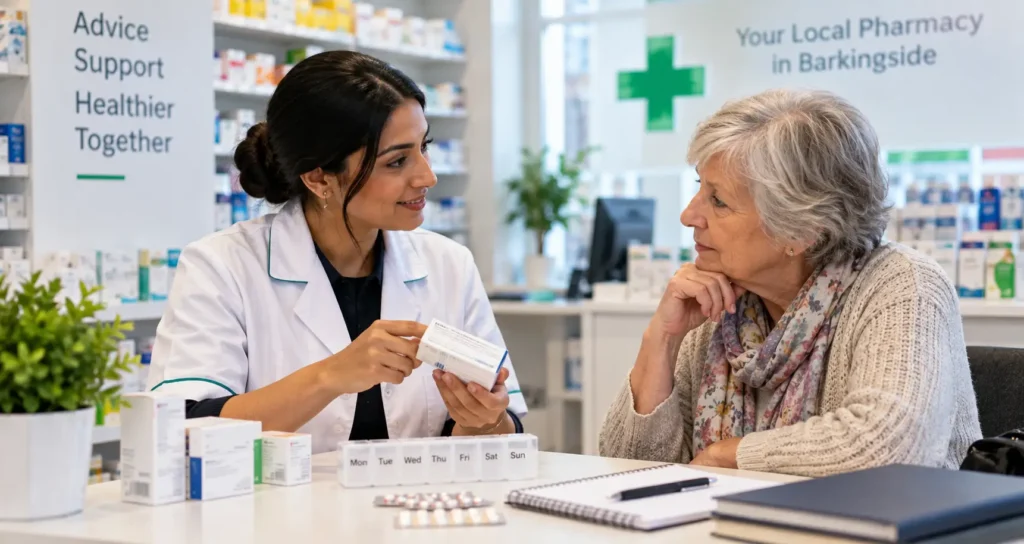
A community pharmacist can help with many of these decisions. NHS guidance says pharmacists can advise on common illnesses, suggest suitable non-prescription treatments where appropriate, answer questions about medicines and refer or signpost people to another health professional when the pharmacy is not the right setting.
That makes the pharmacy a practical clinical advice point, but not a universal treatment service. The pharmacist may sometimes recommend self-care, sometimes provide treatment through an NHS pathway, and sometimes advise you to contact your GP, NHS 111 or urgent care instead.
Everyday medicine questions: what is useful to ask
Medicine questions are one of the most useful reasons for a family to speak to a pharmacist. You may want to check whether a product is suitable for a child’s age, how to use a prescribed medicine, what to do if you are worried about a side effect, or whether an over-the-counter medicine could interact with something already being taken.
For children, age and sometimes weight can affect whether a medicine is suitable and which formulation is appropriate. Always read the label and patient information, use the measuring device supplied with liquid medicine, and ask a pharmacist or doctor if you are unsure. Do not guess a dose or use a medicine that was prescribed for someone else.
When asking on behalf of another family member, try to have the following information ready:
· who the medicine or advice is for, including their age;
· what symptoms they have and when they started;
· any allergies, long-term conditions, pregnancy or breastfeeding information that may matter;
· a list of prescription medicines, over-the-counter medicines and supplements;
· what has already been tried and whether the problem is improving or worsening;
· the medicine packaging or a photo of the label, if the question is about a specific product.
This information helps the pharmacist give safer, more relevant advice. If the person is not with you, there may be limits on what can be assessed or discussed, especially for confidential services.
Minor health concerns and Pharmacy First context
Pharmacists can advise on many minor illnesses. In England, the NHS Pharmacy First service also allows community pharmacies to assess seven common conditions through defined clinical pathways. These pathways have different age ranges, so a condition that can be assessed for one family member may not be suitable for another.
Examples that are particularly relevant to families include earache for children aged 1 to 17, sore throat from age 5, and impetigo or infected insect bites from age 1. Other Pharmacy First pathways have different age criteria. The pharmacist will ask about symptoms and medical history, check for warning signs and decide whether the pharmacy pathway is appropriate.
For the full local condition list and current pathway information, use the dedicated Pharmacy First in Barkingside page. This family guide deliberately does not duplicate the complete eligibility and treatment information from that service page.
Being eligible for a pathway does not guarantee that a medicine will be supplied. The pharmacist still has to assess the individual situation and may recommend self-care or another NHS route instead.
When a GP, NHS 111 or urgent care may be more appropriate
A pharmacy is not the right place for every health problem. Some symptoms need diagnosis, physical examination, tests, ongoing monitoring or treatment outside the pharmacy’s scope. In those situations, the most useful advice from the pharmacist may be to use another NHS service.
A GP is usually more appropriate for persistent, recurring or complex problems that need medical review. NHS 111 can help when you think you need medical help now and are unsure which service is right. NHS 111 may direct you to a pharmacist, GP out-of-hours service, urgent treatment centre or emergency care depending on the symptoms.
For a child under 5, NHS guidance says to call 111 rather than use 111 online. Call 999 or go to A&E for a life-threatening emergency. If someone has severe difficulty breathing, is unconscious, has a seizure that does not stop, or you believe they need immediate emergency treatment, do not wait for a routine pharmacy consultation.
Parents and carers should also trust their concern. If a baby, child, older person or someone with a long-term condition is becoming rapidly more unwell or behaving very differently from normal, explain that clearly when asking for advice.
Prescription and practical medicine support for families
Families often manage regular medicines for more than one person. Keeping an up-to-date medicine list can make pharmacy and GP conversations much easier, particularly for older relatives, people taking several medicines, or anyone whose treatment has recently changed.
A pharmacist can help with questions about how medicines are taken, changes to treatment, new medicines and prescription problems. It is safer to ask before stopping a prescribed medicine, changing the dose, combining medicines or using someone else’s prescription medicine.
If your question is specifically about repeat prescriptions, nomination, collection or local delivery arrangements, use Fullwell Pharmacy’s dedicated prescription support and delivery page. Delivery and medicine availability can depend on the prescription, address, pharmacy capacity and other practical factors, so it should not be assumed in advance.
What to have ready before you visit or call
A short, clear summary helps the pharmacy team understand what you need. Before contacting the pharmacy, it can help to note:
· who needs the advice and their age;
· the main symptom or medicine question;
· how long the problem has been present and whether it is changing;
· important medical conditions, allergies and current medicines;
· any recent advice from a GP, hospital, NHS 111 or another healthcare professional;
· whether you are asking for general advice or a specific NHS/private service.
For a specific clinical service, check the service page first. Some services have age or clinical criteria, and some require an appointment or assessment before treatment can be considered.
Using a pharmacy for families in Barkingside and near Ilford
The Fullwell Pharmacy website lists the pharmacy location as 151 High Street, Barkingside, Ilford, IG6 2AJ. Barkingside is the primary local focus of this guide; Ilford and Redbridge are nearby context rather than separate location targets.
If you are travelling for a particular service, it is sensible to check the relevant page or contact the pharmacy first. Service availability, appointment requirements and medicine stock can change, and clinical services depend on individual eligibility and assessment.
For an overview of the NHS options currently presented on the website, see NHS pharmacy services. If you already know that the service you need uses the online booking route, you can also book a pharmacy appointment.
A useful family habit: keep medicine information organised
A simple medicines list can save time when a family member becomes unwell. Include the name and strength of regular medicines, allergies, important medical conditions and the contact details of the person’s GP surgery. Update the list when treatment changes.
For children, keep medicines in their original packaging, out of sight and reach, and use the supplied measuring device for liquids. Take unwanted or out-of-date medicines to a pharmacy for safe disposal rather than keeping them “just in case” or giving them to another person.
Planning ahead is also useful for repeat prescriptions, holidays and non-urgent appointments. For an urgent health problem, however, use the appropriate urgent NHS route rather than waiting for a planned pharmacy visit.
FAQs
What can a local pharmacy help families with?
A community pharmacy can help with many everyday medicine questions, minor health concerns, prescription queries and decisions about the right next step. The pharmacist may recommend self-care or treatment where appropriate, or direct you to a GP, NHS 111 or another service when pharmacy care is not suitable.
Can I ask a pharmacist about a child’s medicine?
Yes. A pharmacist can advise on many questions about children’s medicines, including whether an over-the-counter product is suitable for the child’s age, how to use a medicine safely and what to do if you are worried about side effects. Bring the medicine or packaging where possible and tell the pharmacist the child’s age, symptoms, allergies and other medicines.
When should I contact a GP or NHS 111 instead?
Use a GP for problems that need diagnosis, ongoing monitoring or medical review. NHS 111 can help when you think you need medical help now and are unsure which service is right; call 111 rather than using 111 online for a child under 5. Call 999 or go to A&E for a life-threatening emergency.
Can families near Ilford use Fullwell Pharmacy?
The Fullwell Pharmacy website lists its location at 151 High Street, Barkingside, Ilford, IG6 2AJ and presents services for people in Barkingside, Ilford and nearby Redbridge areas. If you need a specific clinical service, medicine or appointment, check the relevant service page or contact the pharmacy before travelling.
Important information
This guide provides general information and does not diagnose illness or replace advice from a healthcare professional who has assessed the individual. Medicine and service suitability depend on age, symptoms, medical history, other medicines and the relevant NHS or private service criteria. If symptoms are severe, rapidly worsening or you think someone needs urgent medical help, use NHS 111, urgent care or emergency services as appropriate.
Need help choosing the right pharmacy route?
Start with Fullwell Pharmacy’s NHS pharmacy services page or the dedicated Pharmacy First in Barkingside page if the question is about a minor illness. For a service that uses online booking, use the appointment page. Treatment, medicine supply and appointment availability are always subject to the relevant service and clinical assessment.

 the prescription app