

If you travel abroad for work, a pre-travel health review should be built around the real trip: where you are going, any stopovers, how long you will be away, what your work will involve, your health and medicines, and how soon you leave. For people looking for a travel clinic for business travel in Barkingside, the aim is not to collect as many vaccines as possible. It is to identify the health risks that actually apply to your itinerary and to deal with practical issues such as vaccination timing, malaria risk, carrying medicines, travel insurance and access to care while you are away.
Business trips can be short, frequent and arranged at relatively little notice. That makes preparation easy to postpone. Starting early is still the better option: NHS guidance advises trying to get travel-health advice at least 4 to 6 weeks before travel because some vaccines need time to work or more than one dose. If the trip has been arranged at shorter notice, do not assume that there is nothing useful to discuss; take the itinerary to a travel-health professional and ask what can reasonably be done before departure.
Why business travel needs its own pre-travel plan
A work trip may look straightforward on a calendar but involve several different exposures. A traveller might fly into a major city, transfer through another country, visit an industrial or rural site, attend a conference for several days and then add personal travel before returning home. The health assessment should reflect those details rather than relying on a broad destination label.
The purpose of travel can also change the practical priorities. Frequent flyers may need a repeatable system for checking vaccine records and medicines. Someone working remotely in a rural area may need more detailed advice about medical access, food and water, insects or evacuation arrangements. A traveller with a long-term condition may need to involve their GP or specialist as well as a travel-health service.
Bring an itinerary that reflects the work you will actually do
The most useful travel-health appointment starts with a clear itinerary. Bring your departure and return dates, every country you will visit or transit through, the cities or regions where you will stay, and any planned side trips. If your employer has arranged several flights or a multi-country schedule, include the full routing rather than only the final destination.
It is also worth noting the parts of the trip that could affect health advice: time in rural or remote locations, overnight travel, field work, animal contact, healthcare work, long road journeys, outdoor work, high-altitude locations, or accommodation that is very different from a standard city hotel. The same country can contain areas with different disease risks, so a detailed itinerary helps the clinician give more relevant advice.
Before the appointment, check current destination information on TravelHealthPro and the relevant FCDO foreign travel advice. Entry requirements and health recommendations can change, and transit countries may matter as well as the main destination.
Vaccines are based on destination, itinerary and individual risk
Travel vaccines are not prescribed from a fixed list for every business traveller. The vaccines that may be recommended depend on where you are going, where you will stay within the country, the length and style of travel, previous vaccination history, planned activities and individual health factors. Routine UK vaccinations should also be considered as part of the assessment.
The NHS travel vaccination guidance explains that some travel vaccines are available through the NHS while others are usually private. A pharmacy travel-health service may be able to discuss relevant private vaccination options, but the final recommendation and suitability decision should follow an individual clinical assessment. Do not assume that a vaccine used on a previous business trip automatically covers a new destination or itinerary.
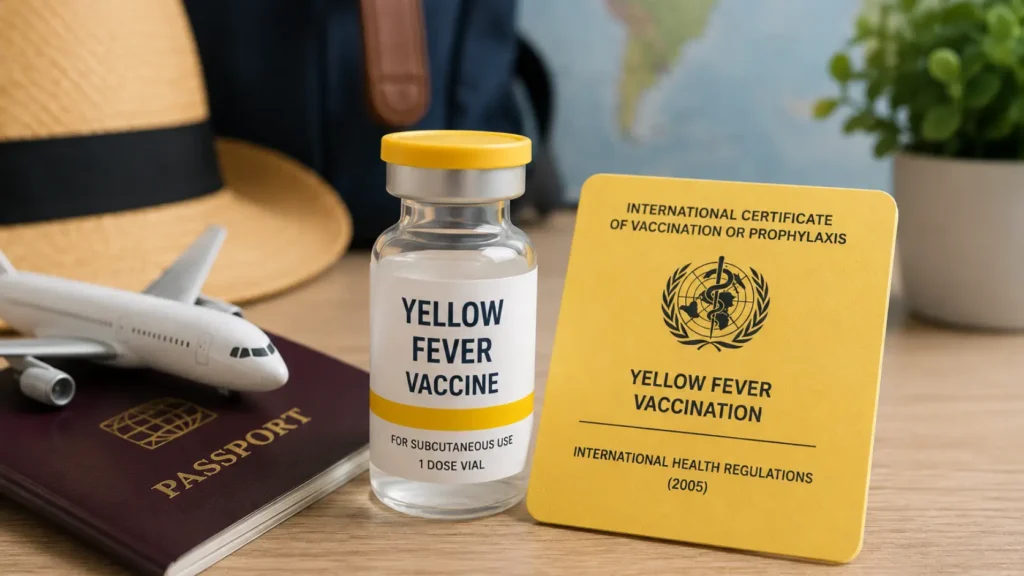
If the trip involves a country with yellow-fever risk or certificate rules, check the current destination guidance early. Yellow-fever vaccination and certification must be handled through an appropriate registered centre. Likewise, malaria advice depends on the exact regions visited, the season, accommodation and the traveller’s medical history; it should not be reduced to a country-wide yes-or-no answer.
Plan regular medicines before a work trip
Business travellers who take regular medicines should prepare before they reach the airport. TravelHealthPro advises allowing time to make sure medication is optimised and that an adequate supply is available. It also recommends carrying medicines in their original pharmacy packaging and taking relevant prescription or prescriber documentation where appropriate.
Different countries have different rules about medicines, including some products that are routinely prescribed or bought over the counter in the UK. Check the rules for every country on the route, including transit points when relevant. The TravelHealthPro medicines and travel guidance is a useful starting point, and the destination’s embassy or official authorities may need to be checked for restricted medicines.
If you cross time zones, do not make ad-hoc changes to the timing or dose of a regular medicine simply to fit the meeting schedule. Ask the clinician who manages the medicine or an appropriate pharmacist how to handle the timing. This is particularly important for medicines where missed or closely spaced doses could cause harm.
Frequent and short-notice travellers need a repeatable system
For people who travel for work several times a year, the simplest way to reduce last-minute problems is to maintain a small travel-health record. Keep a note of routine and travel vaccinations, relevant certificates, regular medicines, allergies, key medical conditions and the details of your insurer. After each trip, update anything that has changed.
When a new trip is booked, run the same check: destination and transit route, current health advice, vaccine record, medicine supply, insurance, entry requirements and any work-specific risks. This is more reliable than assuming that frequent travel means the risks are familiar. Advice can change, and a new worksite or regional visit can alter the assessment even when the country is the same.
Think beyond vaccines: journey, sleep and long periods of sitting
Long-haul travel can affect sleep, hydration and the timing of medicines. Tight schedules can also mean arriving, working and returning with little time to recover from jet lag. Build sensible rest into the itinerary where you can, stay hydrated and avoid relying on alcohol or sedating medicines to manage a difficult journey without clinical advice.
Long periods of immobility are associated with venous thromboembolism, including deep-vein thrombosis and pulmonary embolism. Individual risk varies. Travellers with previous blood clots or other important risk factors should ask their usual healthcare professional whether they need specific preventive advice rather than self-starting medicines or compression garments.
Check insurance and employer arrangements
A corporate travel policy or company booking does not automatically mean that every medical cost or pre-existing condition is covered. The FCDO advises travellers to have appropriate travel insurance and to declare relevant existing health conditions. Review who should be contacted if you become ill, what emergency treatment and repatriation are covered, and whether the policy covers the countries and activities in the itinerary.
If your employer has an occupational-health or travel-risk process, use it alongside individual travel-health advice. For higher-risk work, remote locations or complex medical histories, your employer may need to confirm emergency arrangements, access to local care or evacuation plans. A community travel clinic cannot replace the employer’s duty to manage occupational risk.
The FCDO foreign travel checklist is a useful general pre-departure reference, and its travel insurance guidance explains why medical conditions and planned activities need to be covered.
What a community pharmacist can help with
A pharmacist providing travel-health services can help you organise the clinical part of pre-travel preparation. Depending on the service and your individual assessment, this may include reviewing the itinerary, discussing vaccination history, considering destination-specific vaccine advice, talking through malaria-prevention options where relevant, and helping you identify medicine or health questions that need another clinician.
Fullwell Pharmacy’s current website lists travel-health consultations and vaccination support at its Barkingside location. Use the main travel clinic page for current service information and the appointment page to check the available booking route. Vaccine stock, appointment availability, suitability and any treatment or prescription decision should always be confirmed at the time of assessment.
When another NHS or clinical service is more appropriate
A travel-clinic appointment is not a substitute for ongoing medical care. Speak to your GP or usual clinical team if a long-term condition is unstable, you have recently been admitted to hospital or had surgery, your regular treatment has changed, or you need advice about fitness to fly. If you use specialist equipment, require oxygen, have mobility needs or need complex medicine planning, contact the relevant clinician and transport provider early.
Use NHS 111 when you need urgent medical advice and are unsure which service to use. For severe or life-threatening symptoms, call 999 or go to A&E. If you become unwell during or after an international business trip, tell the healthcare professional where you travelled, the dates, and any important exposures or treatment received abroad.
A practical business-travel health checklist
· Write down the full itinerary, including transit countries and regional work locations.
· Check TravelHealthPro and FCDO advice for every country on the route.
· Try to arrange travel-health advice 4 to 6 weeks before departure where possible.
· Bring your vaccination history, medicine list, allergies and relevant health information.
· Check the destination rules for carrying prescription and over-the-counter medicines.
· Make sure you have enough regular medicine for the trip and reasonable travel disruption.
· Review whether malaria, insect-bite, food-and-water or other destination risks apply.
· Check corporate and personal travel insurance, including pre-existing conditions and repatriation.
· Discuss unstable medical conditions, recent surgery or fitness-to-fly questions with the clinician who manages them.
· Recheck official travel and entry guidance close to departure, especially for multi-country trips.
Business-travel health advice in Barkingside
Fullwell Pharmacy is based at 151 High Street, Barkingside, Ilford. For travellers in Barkingside and nearby parts of Ilford and Redbridge, the pharmacy may be a convenient local starting point for travel-health preparation. This guide owns the narrower informational topic of preparing for business travel; the main travel-clinic page remains the owner for service availability, booking, broad travel-vaccination information and commercial/local “travel clinic Barkingside” intent.
If you are preparing for a work trip, review the Fullwell Pharmacy travel clinic information and confirm the current appointment route before relying on a specific vaccine, medicine or certificate service. For a broader pre-travel checklist, you can also read the travel health tips for Barkingside travellers.
Frequently asked questions
What should I know about a travel clinic for business travel?
A business-travel health review should be based on the actual itinerary, not simply the country name. Bring your destinations, stopovers, travel dates, work locations and planned activities, together with your vaccination history, regular medicines and relevant health information. This allows the clinician to consider destination-specific vaccination, malaria and other health risks, medicine planning and whether another clinician should be involved.
Can I ask a pharmacist in Barkingside about travel clinic for business travel?
Yes. A pharmacist offering travel-health services can be a useful first point of contact for destination-specific travel advice, vaccination questions and practical medicine planning. Any vaccination, malaria-prevention medicine or other treatment remains subject to an individual assessment and current service availability.
When should I contact a GP, NHS 111 or urgent care instead?
Contact your GP or usual clinical team if you need management of an ongoing condition, have had a recent deterioration or hospital admission, need fitness-to-fly advice, or require a significant change to regular treatment. Use NHS 111 when you need urgent medical advice and are unsure where to go. For a life-threatening emergency, call 999 or go to A&E.
Is Fullwell Pharmacy convenient for patients near Ilford and Redbridge?
Fullwell Pharmacy is located at 151 High Street in Barkingside, Ilford, so it may be convenient for people travelling from nearby parts of Ilford and Redbridge. Check the current travel-clinic information and appointment availability before making a special journey.
Medical disclaimer
This guide provides general travel-health information and does not replace an individual clinical assessment. Vaccination, malaria-prevention and medicine advice depends on the traveller, destination, itinerary, medical history and current guidance. Entry and certificate requirements can change, so check official destination advice before travel.




 the prescription app