
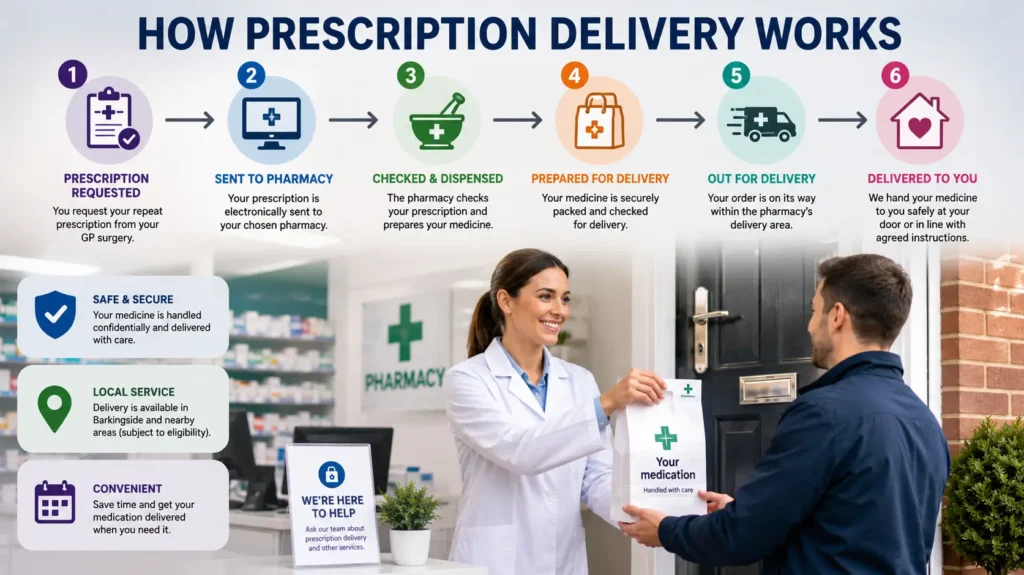
Prescription delivery usually follows a simple chain: a prescription is requested or issued, sent to a pharmacy, checked and dispensed, and then prepared for collection or delivery if that pharmacy offers delivery and the prescription is suitable. Delivery is an extra access step after prescribing and dispensing – it does not guarantee that every prescription can be delivered, that delivery will be free, or that medicines will arrive at a fixed time.
If you want Fullwell-specific information about local availability, use the prescription delivery in Barkingside service page. The guide below focuses on the general process so you know what happens between requesting a prescription and receiving your medicines.
1. How a prescription reaches the pharmacy
The first step is for a valid prescription to be issued by an appropriate prescriber. For regular medicines, this often starts when you request a repeat prescription through your GP surgery, the NHS App, the NHS website or another route your GP practice supports.
A repeat request is not the same as an issued prescription. Your GP practice or prescriber may need to approve the request before the pharmacy can prepare the medicine. If a request is too early, a medicine review is due, or the prescription needs changing, the prescriber may need to deal with that before anything is sent to the pharmacy.
Once an electronic prescription has been issued, it can be sent through the Electronic Prescription Service to the pharmacy you have chosen. If you have not chosen a pharmacy, some prescriptions can instead be collected using the prescription barcode shown in the NHS App.
2. Do you need to nominate a pharmacy for delivery?
Not always, but choosing or nominating a pharmacy can make the process simpler when you regularly use the same pharmacy. Your chosen pharmacy receives electronic prescriptions sent to it until you change or remove that choice.
Nomination does not mean you are permanently tied to one pharmacy. You can change your chosen pharmacy, including through the NHS App where that feature is available to you. It also does not automatically enrol you in a home-delivery service. Delivery is a separate service with its own availability and handover arrangements.
If you want medicines delivered, check with the pharmacy whether delivery is available for your address and whether the particular prescription can be included.
3. What happens when the pharmacy receives the prescription?
After the pharmacy receives the prescription, the pharmacy team needs to process it before supply. This includes confirming the prescription details, preparing the correct medicine and carrying out the checks required before the medicine can be handed over.
Sometimes the process is straightforward. At other times, the pharmacy may need to resolve a query, wait for a medicine to arrive, or contact the prescriber if something on the prescription needs clarification. A delivery cannot safely bypass those steps.
This is why ‘my GP approved it’ and ‘my medicine is ready for delivery’ are not always the same status. There can be a preparation stage between the two.
4. Preparing medicines for delivery
Once the prescription has been processed and the medicines are ready, the pharmacy can confirm whether collection or delivery is the appropriate next step. The exact process varies between pharmacies.
A pharmacy may need to check your delivery details, confirm that the address is within its current service area, and decide whether the medicine can be delivered under its procedures. Some prescriptions may need collection or additional arrangements rather than routine delivery.
Do not assume a driver will leave prescription medicines unattended. Handover requirements can vary according to the medicine and the pharmacy’s procedures, so follow the instructions given by the pharmacy.
5. Delivery eligibility, service area and charges
Prescription delivery is not automatically available to every patient or every address. A pharmacy may limit delivery according to its local service area, capacity, the type of prescription or medicine, and the arrangements it has in place at that time.
Delivery is also not automatically free. A pharmacy may provide free delivery in some circumstances, may charge for some delivery arrangements, or may have eligibility rules. Ask the pharmacy for its current terms rather than relying on an old website claim or a policy used by another pharmacy.
NHS prescription charges are a separate issue. In England, the usual NHS prescription charge rules may still apply unless you are exempt. Whether you pay an NHS prescription charge does not, by itself, tell you whether a pharmacy charges for delivery.
6. What prescription delivery does not guarantee
· It does not guarantee that a prescriber will issue or approve a prescription.
· It does not guarantee that every medicine is immediately in stock.
· It does not guarantee that every prescription is suitable for delivery.
· It does not guarantee a same-day or fixed-time delivery unless the pharmacy has specifically confirmed that arrangement.
· It does not replace urgent medical care or an emergency prescription route.
· It does not mean NHS prescription charges are waived if you normally have to pay them.
7. What if a prescription is urgent, changed or delayed?
If you need medicine urgently
Do not wait for a routine delivery slot if you are about to run out of an important prescribed medicine. Contact your GP surgery or the pharmacy as soon as possible. If you have run out of a regular prescribed medicine and need help urgently, NHS 111 online or 111 can advise on emergency prescription options.
If you have severe symptoms or a medical emergency, use the appropriate urgent or emergency healthcare route rather than relying on a prescription-delivery service.
If your prescription has changed
If your prescriber changes, replaces or cancels a medicine, the pharmacy needs the current valid prescription before it can supply the updated medicine. Contact the pharmacy if you are unsure which version it has received.
If a changed treatment leaves you with medicines you no longer need, do not share them with somebody else. You can read Fullwell’s guidance on how to return unwanted medicines safely.
If the prescription is delayed
First identify where the delay is. If the prescription is still waiting for prescriber approval, your GP surgery may need to help. If the pharmacy has received it but the medicine is not ready, the pharmacy can explain whether it is being prepared, whether an item is outstanding, or whether another issue needs resolving.
The NHS App can show prescription status for some users and pharmacies, but tracking is not available in every situation. If the information is unclear and you are running low on medicine, contact the appropriate service rather than waiting without advice.
8. What happens if you miss a medicine delivery?
Missed-delivery arrangements vary by pharmacy. The safest next step is to contact the pharmacy and ask whether the medicine will be redelivered or should be collected.
Do not assume prescription medicines can be left in a porch, with a neighbour or in another unattended place. The pharmacy may have specific handover requirements, and some medicines may need different arrangements.
If the missed delivery means you may run out before the next available handover, tell the pharmacy that the medicine is time-sensitive and ask what you should do. For urgent repeat-medicine problems, NHS 111 can advise on emergency options.
9. Practical ways to reduce prescription delays
· Request regular repeat medicines before you run out, allowing time for prescriber approval and pharmacy preparation.
· Check that your chosen pharmacy is correct if you expect the prescription to be sent electronically.
· Keep your address and contact details up to date with the pharmacy if you use a delivery service.
· Tell the pharmacy promptly if your prescriber has changed or cancelled a medicine.
· If you are expecting several items, check whether all of them are ready before relying on a delivery date.
· Ask about delivery eligibility, current service area and any delivery charge rather than assuming the service is automatic or free.
· For urgent medicine needs, contact the GP surgery, pharmacy or NHS 111 as appropriate instead of waiting for routine delivery.
10. Using Fullwell Pharmacy for prescription delivery
Fullwell Pharmacy’s website provides a dedicated page for repeat prescription support, pharmacy nomination and delivery where available. For current local details, use the prescription delivery in Barkingside page or contact the pharmacy before relying on delivery for a particular prescription.
If you are looking for broader local pharmacy information, visit Fullwell Pharmacy in Barkingside. Availability, delivery area, charges and handover arrangements can change, so confirm the current service if those details matter to you.
Frequently Asked Questions
How does prescription delivery work?
A prescription is issued or approved by a prescriber, sent to a pharmacy, checked and dispensed, and then prepared for collection or delivery where the pharmacy offers delivery and the prescription is suitable. Delivery arrangements, timing and eligibility vary by pharmacy.
Do I need to nominate the pharmacy for delivery?
Not always. Choosing or nominating a pharmacy can make electronic prescriptions easier to route to the same pharmacy, but you can change your chosen pharmacy and some prescriptions can be collected using a prescription barcode when no pharmacy is nominated.
Is prescription delivery automatically free?
No. Delivery charges and eligibility depend on the pharmacy’s current service terms. NHS prescription charges may also apply in England unless you are exempt, and those charges are separate from any delivery fee.
Can all prescriptions be delivered?
Not necessarily. Delivery can depend on the medicine, prescription type, pharmacy procedures, your location and service availability. The pharmacy should confirm whether a particular prescription can be delivered.
What happens if I miss a medicine delivery?
Contact the pharmacy for its redelivery or collection arrangements. Do not assume medicines will be left unattended, because handover requirements can vary by medicine and pharmacy procedure.
What should I do if I need my prescription urgently?
Contact your GP surgery or pharmacy as soon as possible. If you have run out of a regular prescribed medicine and need it urgently, NHS 111 online or 111 can advise on emergency prescription options. Do not rely on a routine delivery slot for urgent medicine.
Disclaimer
This guide provides general information about prescription processing and pharmacy delivery in England. It does not replace advice from your prescriber or pharmacist, and it does not guarantee that a prescription, medicine or delivery service will be available. Delivery eligibility, service areas, charges, timing and handover arrangements vary. If you need a regular prescribed medicine urgently, contact your GP surgery, pharmacy or NHS 111; use emergency services for a medical emergency.

 the prescription app