
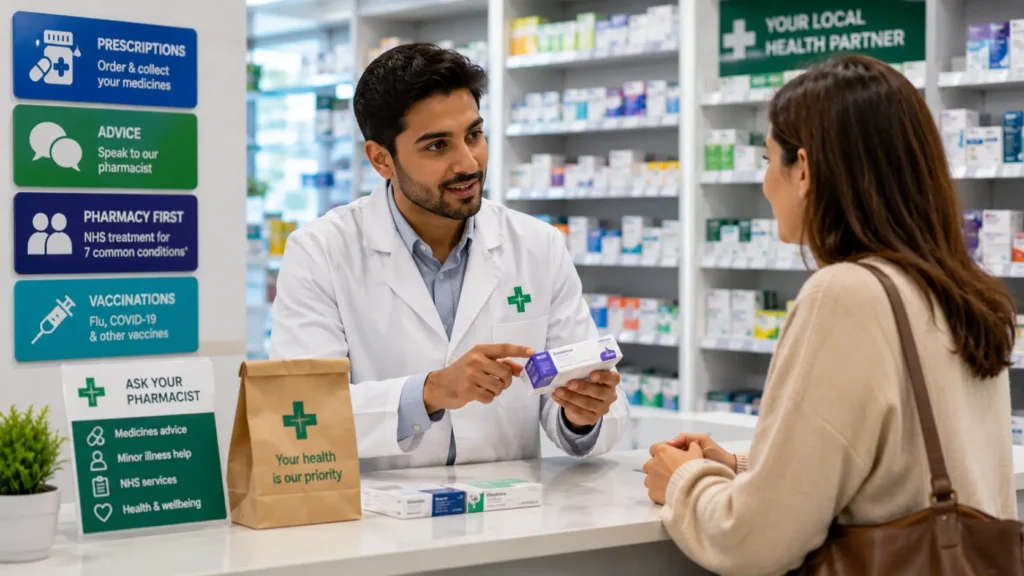
A local pharmacy is often a practical first stop when you need help with medicines, a minor health concern, a repeat prescription or an NHS pharmacy service. You do not have to be seriously unwell to speak to a pharmacist, and you do not always need a GP appointment before asking a pharmacy team for advice. Knowing when to use a local pharmacy can help you choose the right level of care without delaying help when something more urgent is happening.
Community pharmacists are qualified healthcare professionals with expertise in medicines and common health problems. NHS England says community pharmacy teams can support people with minor illnesses, taking medicines, healthy-living advice and a growing range of clinical services. The exact services available vary by pharmacy, so it is sensible to check before travelling specifically for an appointment or treatment.
Who is a local pharmacy for?
A local pharmacy is for anyone who needs accessible advice about medicines or everyday health problems. That includes people taking regular prescriptions, parents and carers managing medicines for someone else, people who have recently started a new medicine, and people who are unsure whether a minor illness needs self-care, pharmacy treatment or assessment elsewhere.
It can also be useful when you want to ask a confidential question without starting with a GP appointment. Pharmacies commonly have private consultation areas for clinical services, and the pharmacist can explain when your symptoms or circumstances mean you should use another NHS service instead.
1. Use a local pharmacy when you have questions about medicines
One of the clearest times to use a local pharmacy is when you are unsure about a medicine. A pharmacist can help explain how a medicine should be taken, how to use a device such as an inhaler, what to do if you are worried about a side effect, and whether an over-the-counter product may interact with medicines you already use. They can also help you understand changes made after a hospital stay or a new prescription.
If you are taking several medicines, bring an up-to-date list or show the pharmacy team the medicines you currently use. Do not stop, start or change the dose of a prescribed medicine on the basis of general web information; ask the pharmacist, prescriber or another appropriate clinician for advice about your own treatment.
2. Use a local pharmacy for minor illness advice and Pharmacy First
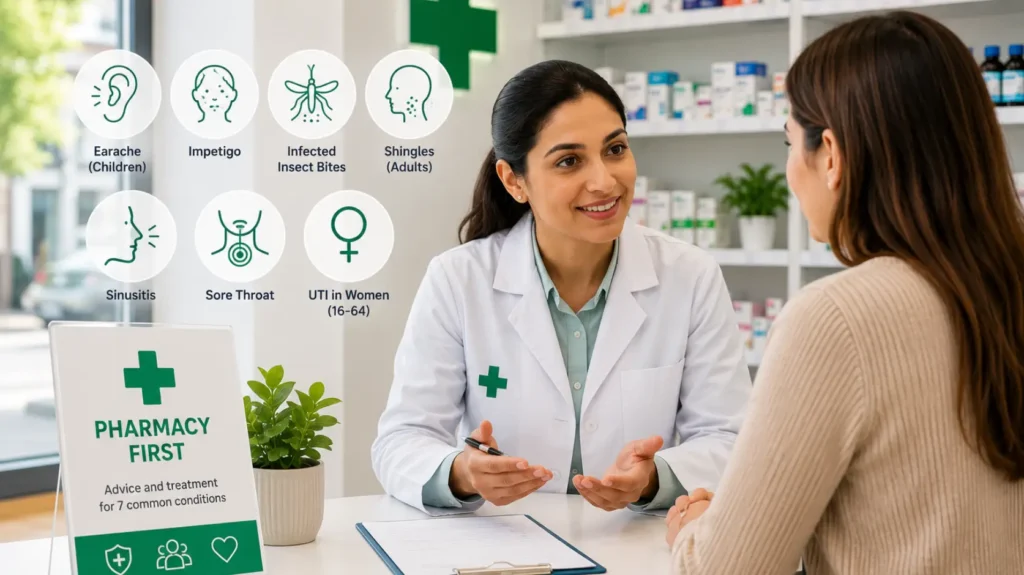
Another common reason to use a local pharmacy is a minor illness. Pharmacy teams can give self-care advice, recommend suitable over-the-counter treatment where appropriate, and identify warning signs that need another service. In England, NHS Pharmacy First also allows participating community pharmacies to assess seven defined clinical pathways: sinusitis, sore throat, acute otitis media in children, impetigo, infected insect bites, shingles and uncomplicated urinary tract infections in eligible women aged 16 to 64.
If you are in Barkingside or nearby and think one of those pathways may apply, read the current Pharmacy First in Barkingside information before attending. Eligibility, clinical assessment and referral rules still apply, and a consultation does not guarantee that a medicine will be supplied.
3. Use a local pharmacy for repeat prescriptions and prescription support
A pharmacy is also the natural place to ask practical questions about repeat prescriptions: whether an electronic prescription has arrived, how to nominate a pharmacy, what to do if an item is unavailable, or how early to request regular medicines. The Electronic Prescription Service allows prescriptions to be sent electronically to a dispenser chosen by the patient, and the NHS App can be used to manage a nominated pharmacy and track prescriptions in supported workflows.
Request repeat medicines with enough time for your prescriber to approve them and for the pharmacy to obtain stock if necessary. If you are close to running out of an important medicine, contact the pharmacy, your GP practice or NHS 111 promptly rather than assuming a routine delivery or collection will be immediate.
For local information about collection, nomination and delivery where available, see prescription delivery and repeat prescription support. Availability can depend on the prescription, address, pharmacy capacity and whether delivery is suitable.
4. Use a local pharmacy when you want help choosing an over-the-counter treatment
Pharmacists can help you choose an over-the-counter treatment for many common problems, but the useful part is not simply buying a product. The pharmacy team can ask about your symptoms, age, allergies, pregnancy or breastfeeding, medical conditions and current medicines before suggesting whether self-care is reasonable or whether you need assessment elsewhere.
This is especially valuable if you are buying a medicine for a child, an older person, someone with a long-term condition or someone already taking several medicines. Always follow the product information and ask if you are unsure how long to use a treatment or when to seek further help.
5. Use a local pharmacy for selected NHS services
Community pharmacies in England can provide a range of NHS services in addition to dispensing prescriptions. Depending on the pharmacy, these may include Pharmacy First, blood-pressure checks, the NHS Pharmacy Contraception Service, the New Medicine Service, seasonal vaccination services and other locally commissioned support.
The important point is that not every pharmacy provides every service every day. Service availability can change because of staffing, stock, commissioning, eligibility or local governance. If you are travelling specifically for a service, check the current service page or contact the pharmacy first.
6. Use a local pharmacy when you need a healthcare professional to point you in the right direction
You do not need to know exactly what service you require before asking a pharmacist. A pharmacy team can often help you decide whether a problem is suitable for self-care, an NHS pharmacy pathway, a GP appointment, NHS 111, urgent treatment or emergency care. This “right place” function is one reason knowing when to use a local pharmacy can save time without treating the pharmacy as a substitute for every other part of the NHS.
If your symptoms are severe, rapidly worsening, involve difficulty breathing, severe chest pain, heavy bleeding, collapse, signs of stroke or another life-threatening emergency, use emergency services rather than waiting for routine pharmacy advice. For urgent problems that are not life-threatening, NHS 111 can help direct you to the right service.
When should you use a GP, NHS 111 or emergency care instead?
A pharmacy is not the right destination for every health concern. A GP or another clinician may be more appropriate when symptoms are persistent, recurring, unexplained, worsening or need diagnosis, examination, monitoring or treatment outside the pharmacy’s scope. NHS 111 is useful when you need urgent advice and are not sure where to go.
Call 999 or attend A&E for a medical emergency. Examples include severe difficulty breathing, suspected stroke, severe chest pain, loss of consciousness, major trauma or other immediately life-threatening symptoms. If you are unsure whether a situation is an emergency, NHS guidance should take priority over an online article.
How to get more value from your local pharmacy
· Keep an up-to-date list of your prescription and over-the-counter medicines.
· Tell the pharmacist about allergies, pregnancy or breastfeeding, long-term conditions and medicines from other providers when relevant.
· Ask whether a private consultation area is available if the issue is sensitive.
· Check service availability before travelling specifically for a vaccination, clinical service or appointment.
· Order repeat prescriptions before you run out and allow time for GP approval and stock ordering.
· Use the same nominated pharmacy consistently when that helps the team understand your regular medicine history, while remembering you can change your nomination.
Using a local pharmacy in Barkingside
If you live in Barkingside, Ilford or nearby, Fullwell Pharmacy in Barkingside is the main local service and pharmacy-information page for this website. Use the homepage to see current local service routes, but check any specific service before travelling because availability and eligibility can change.
The registered pharmacy at 151 High Street, Barkingside, Ilford (GPhC reference 9012732) was reinspected by the General Pharmaceutical Council on 6 August 2026 and the inspection outcome is currently “Standards met”. The same GPhC update states that the travel-clinic and weight-management services have stopped. Because the Fullwell website still contains pages promoting those services, this article deliberately does not present them as currently available.
The simple rule: start with the pharmacy when the need fits pharmacy care
If you are deciding when to use a local pharmacy, think about the type of help you need. Medicines, repeat prescriptions, minor illness advice, Pharmacy First and selected NHS pharmacy services are all common reasons to start there. A pharmacist can also tell you when another service is more appropriate.
The safest approach is not to use the pharmacy for everything, but to use it confidently for the problems it is designed to handle. For urgent or serious symptoms, use the appropriate GP, NHS 111 or emergency route without delay.
Prepared by Fullwell Pharmacy Editorial Team.
FAQs
What can a local pharmacy help with?
A local pharmacy can help with prescriptions, medicine questions, over-the-counter treatment choices, minor illness advice and selected NHS pharmacy services. The exact services vary by pharmacy.
Do I need an appointment to speak to a pharmacist?
Not always. Many pharmacies can provide general advice without a booked appointment, while some clinical services use appointments or have specific availability. Check before travelling for a particular service.
Can a pharmacist treat minor illnesses?
Pharmacists can advise on many minor illnesses and, under NHS Pharmacy First in England, participating pharmacies can assess seven defined clinical pathways. Eligibility and clinical criteria apply.
Can a local pharmacy help with repeat prescriptions?
Yes. Pharmacy teams can help with nomination, electronic prescriptions, collection and practical repeat-prescription queries. Your GP or prescriber still needs to authorise medicines that require a prescription.
When should I use NHS 111 instead of a pharmacy?
Use NHS 111 when you need urgent medical advice and are not sure which service is appropriate, or when a problem is outside routine pharmacy scope but is not a life-threatening emergency.
When should I call 999 rather than go to a pharmacy?
Call 999 for a life-threatening emergency, such as severe breathing difficulty, suspected stroke, severe chest pain, loss of consciousness or major trauma. Do not wait for routine pharmacy advice in an emergency.
Disclaimer: This article provides general information about community pharmacy access in England. It does not diagnose symptoms or replace personalised advice from a pharmacist, GP or other healthcare professional. Pharmacy services, eligibility and availability can change. For urgent medical help use NHS 111, and for a life-threatening emergency call 999.




 the prescription app