

A local pharmacy can do much more than hand over prescriptions. It can be a practical first point of contact for medicine questions, minor health concerns and several NHS services. If you are wondering how to use a local pharmacy, the simplest approach is to think of the pharmacy as both a medicines service and a place to ask a qualified pharmacist what the safest next step should be.
For people in Barkingside and nearby Ilford, this guide explains the everyday journey: choosing a pharmacy, ordering and collecting prescriptions, asking for medicine advice, using Pharmacy First when eligible, and knowing when a GP, NHS 111 or emergency care is more appropriate. The exact services available can vary by pharmacy and by clinical suitability.
What can a local pharmacy help with?
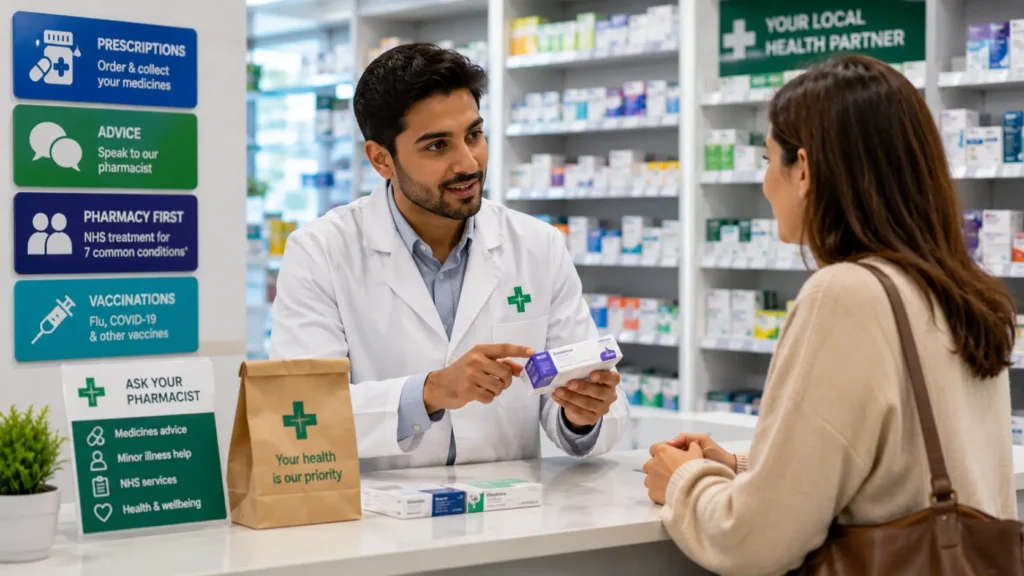
NHS guidance says pharmacists can advise on a range of common illnesses and on medicines, including how to use them and what to do if you are worried about side effects. If the pharmacy team cannot safely manage the issue, they can direct you to a GP or another healthcare professional. That makes a local pharmacy useful not only when you need to collect medicine, but also when you need help deciding what to do next.
Common reasons people use a community pharmacy include collecting prescriptions, asking questions about medicines, buying appropriate over-the-counter treatments, disposing of unwanted medicines safely, getting support with a newly prescribed medicine, and accessing selected NHS or private services. Not every pharmacy offers every service, so it is sensible to check before travelling for a specific appointment or vaccination.
If you want to see the main local services and contact routes, start with Fullwell Pharmacy in Barkingside. This homepage should remain the main page for broad local pharmacy and Barkingside service discovery; this article is intentionally narrower and informational.
How prescriptions work through a local pharmacy
A repeat prescription usually starts with a request to your GP practice. NHS App guidance says that, where the feature is available, you can request repeat medicines in the app and choose the pharmacy that should receive the prescription electronically. The GP still needs to approve the request before it is sent to the pharmacy.
Choosing a pharmacy — often called nominating a pharmacy — means electronic prescriptions can be sent to that pharmacy until you change the choice. NHS guidance also notes that if you do not have a chosen pharmacy, a prescription barcode in the NHS App may allow you to collect from a pharmacy of your choice. Preparation time can vary, and some medicines may need to be ordered, so urgent requests should be discussed directly with the appropriate healthcare service rather than assumed to be immediately available.
To make the process smoother, request regular medicines before you run out, check the status shown in the NHS App where available, and tell the pharmacy if your medicines, allergies or contact details have changed. If you are unsure whether a prescription has reached the pharmacy, ask before making a special journey.
When can a pharmacist help instead of a GP?
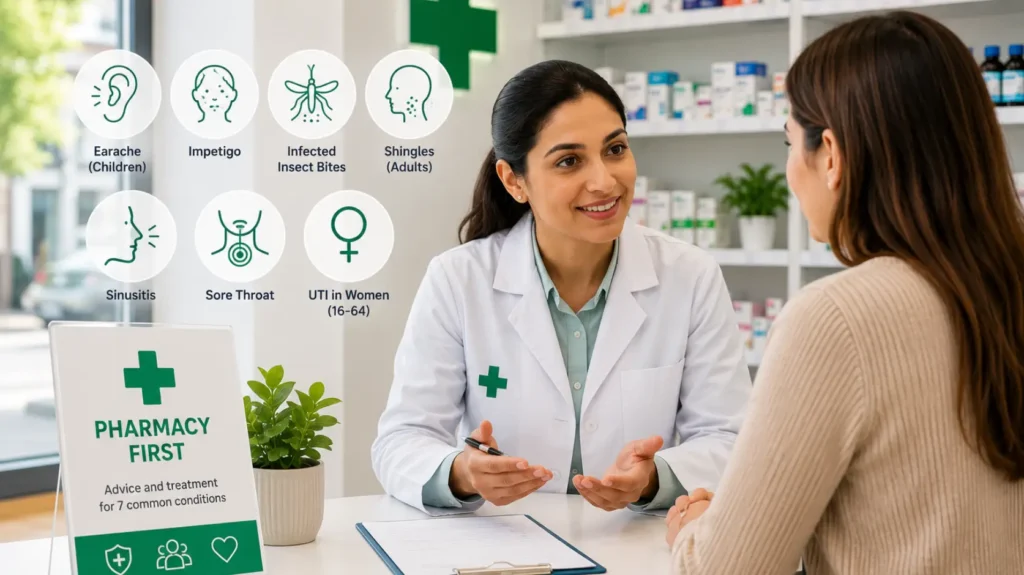
For many everyday questions, the pharmacist can give advice without you needing a GP appointment. NHS Pharmacy First also allows community pharmacies in England to complete care for seven defined clinical pathways: sinusitis, sore throat, earache in children, impetigo, infected insect bites, shingles and uncomplicated urinary tract infections in eligible women. Each pathway has age and clinical criteria, and treatment is supplied only when appropriate after assessment.
If your symptoms fit one of those pathways, read the local Pharmacy First in Barkingside information before attending. The service page should remain the transactional owner for Pharmacy First; this guide only explains where that service fits within the wider role of a local pharmacy.
Pharmacy First is not a guarantee that you will receive antibiotics or another prescription-only medicine. The pharmacist follows a clinical pathway, provides self-care and safety-netting advice, and supplies a restricted medicine only when the criteria are met. If the condition is outside the pathway, more serious, or needs another examination, the pharmacist may advise GP, NHS 111, urgent care or emergency support instead.
What happens when you ask a pharmacist for advice?
When you approach the pharmacy counter, a team member may first ask what you need help with. For a clinical or medicine-related question, the pharmacist may need to ask about symptoms, how long they have been present, medicines you already take, allergies, pregnancy or breastfeeding where relevant, and other health conditions. Some discussions are better handled in a private consultation area.
The outcome may be simple self-care advice, an over-the-counter option, help with using a medicine, a Pharmacy First assessment, or referral to another service. The important point is that how to use a local pharmacy safely means giving the pharmacist enough accurate information to understand the situation rather than expecting a particular medicine before the assessment.
What should you bring to the pharmacy?
For a routine prescription collection, follow any message or collection instructions you have been given and bring identification if the pharmacy asks for it. For a medicine question, it can help to bring the medicine packaging or an up-to-date list of medicines and doses. If you are asking about symptoms, be ready to explain when they started and what you have already tried.
For a booked clinical service, the information needed depends on the service. For example, a travel consultation may require an itinerary and vaccination history, while another appointment may require details of medical conditions or current medicines. Check the specific service information before attending rather than assuming every consultation follows the same process.
Do you always need an appointment?
Not always. General medicine advice is often available by contacting or visiting a pharmacy, and the NHS says patients can access the seven Pharmacy First clinical pathways by attending or contacting a pharmacy directly. However, the practical arrangements for a particular pharmacy can vary with staffing, workload and the service you need.
Fullwell’s current booking page lists selected NHS and private pharmacy services and states that availability can vary by service, appointment time, clinical suitability and pharmacy capacity. If you need a specific service rather than general advice, use the book an appointment route or contact the pharmacy before travelling. Booking an appointment does not guarantee a medicine, vaccination, prescription or treatment; clinical assessment still applies.
How to make your local pharmacy easier to use
· Choose or update your pharmacy in the NHS App if you want repeat prescriptions sent there electronically.
· Request regular medicines in good time rather than waiting until the last dose.
· Ask medicine questions early, especially if you are unsure how to take a new medicine or are worried about side effects.
· Check whether a specific NHS or private service is available before travelling for it.
· Bring accurate information about medicines, allergies and relevant medical history to clinical consultations.
· Tell the pharmacist if symptoms are worsening, severe, unusual or accompanied by red-flag symptoms rather than minimising them.
· Use the pharmacist as a route to the right level of care — not as a replacement for urgent or emergency services when those are needed.
These habits make how to use a local pharmacy more efficient because the pharmacy team has the information and time needed to help, while you avoid unnecessary journeys and delays.
A local example in Barkingside
The premises at 151 High Street, Barkingside, Ilford, IG6 2AJ is listed by the NHS and GPhC as Pyramid Pharmacy, while the website markets the location as Fullwell Pharmacy. Current official records confirm community-pharmacy services at the premises, including prescription services and Pharmacy First. Because the legal/trading-name relationship between the Fullwell website brand and the registered Pyramid Pharmacy name has not been independently reconciled, publication should avoid claiming that “Fullwell Pharmacy” is the registered GPhC name.
For the local user journey, the practical next step is to use the Fullwell website for service information and contact routes, while official registration information should remain consistent with NHS and GPhC records. Do not rely on conflicting legacy location or opening-hours copy elsewhere on the site when planning a visit.
When should you seek help elsewhere?
A pharmacist can help with many common questions, but not every problem is suitable for pharmacy care. If symptoms are severe, rapidly worsening, involve significant breathing difficulty, loss of consciousness, severe bleeding, or another emergency, call 999. For urgent problems that are not life-threatening, NHS 111 can help you find the right service. If the pharmacist identifies a need for GP assessment, tests or another clinician, follow that referral advice.
Conclusion: using a local pharmacy with confidence
Knowing how to use a local pharmacy can save time and help you get the right support sooner. Use the pharmacy for prescription collection, medicine questions, appropriate over-the-counter advice and eligible NHS services such as Pharmacy First, while remembering that clinical criteria and service availability still apply.
If you are local to Barkingside or Ilford, you can check current service information through Fullwell Pharmacy in Barkingside and use the booking route for selected services. If you are unsure whether the pharmacy can help with your specific need, contact the team before travelling.
Frequently asked questions
Do I need an appointment to speak to a pharmacist?
Not always. General advice is often available by contacting or visiting a pharmacy, but appointments or advance checks may be needed for specific clinical or private services. Contact the pharmacy if you are travelling for a particular service.
Can a pharmacist provide prescription medicine without a GP appointment?
For eligible patients, Pharmacy First can allow a pharmacist to supply certain prescription-only medicines for seven defined clinical pathways when the clinical criteria are met. It is not a guarantee of medicine supply.
Can I change which pharmacy receives my prescriptions?
Yes. NHS guidance says you can choose or change your pharmacy in the NHS App or NHS website where the feature is available. Outstanding prescriptions may still go to the previous pharmacy, so check before travelling.
Can a pharmacist help if I am worried about a side effect?
Yes. NHS guidance says pharmacists can advise on medicines, including how to use them and concerns about side effects. They can also direct you to another healthcare professional if the issue needs further assessment.
What happens if the pharmacist cannot treat my problem?
The pharmacist can advise on the next appropriate step. Depending on the situation, that may be self-care, a GP, NHS 111, urgent care or emergency services.
Should I contact the pharmacy before travelling for a specific service?
Yes. Service availability, appointment times, stock and clinical suitability can vary. Contacting or booking ahead can help confirm the practical arrangements, but it does not guarantee treatment or supply.
Disclaimer
This article provides general information about using community-pharmacy services in England. It is not a diagnosis or personalised medical advice. Pharmacy services, eligibility, appointment arrangements and medicine supply can change and depend on clinical assessment. For urgent medical concerns use NHS 111; call 999 for a life-threatening emergency.



 the prescription app